Books 2-3 are omitted in our abridged version of the epic, which follows Telemachus sailing to the Peloponnesus for word of his father and a means to protect his inheritance. He first lands on the southern shores of Pylos, the kingdom ruled by Nestor, and is welcomed with all the affection and respect of a proper guest-friend according to bonds of xenia (hospitality). After hearing of Nestor’s experiences, but learning no more about the fate of Odysseus, Telemachus journeys overland to Sparta in hopes of finding out more from Menelaus and Helen. His interactions with the king and queen of Sparta makeup the entirety of our excerpts from Book 4. We learn what happened to Menelaus and Helen as they struggled to return home from Troy.
In many ways, their story is an abbreviated version of Odysseus’ trek. Although their struggle did not last nearly as long as that of Odysseus, it was rife with unexpected struggles and suffering. It also represents or alludes to some of the other, similar difficulties encountered by the rest of the heroes in the Greek expedition as they attempted to return home from Troy. Many of these stories were told in a separate epic simply referred to as The Returns.
Thus, the excerpted story of Helen and Menelaus that we analyze below should be viewed as a parallel to that of Odysseus’ own struggle; an example of xenia practiced properly; an endcap to the Trojan War continued from the Iliad (Troy does not fall in the Iliad, but the death of Hektor is made to represent the impending doom of the city itself); and finally as another fantastical and exhilarating adventure in an epic full of such interactions between humans, gods, and monsters.
The abridged text begins with the introduction of Helen to the room in which Menelaus entertained Telemachus. The description of Helen’s arrival is worth a brief examination because it reinforces relatively stock gender expectations of women in the Iliad, Odyssey, Homeric Hymn to Demeter, and other Archaic and Classical myths:
Helen came from her fragrant bedroom
Like gold-spindled Artemis. Adraste,
Her attendant, drew up a beautiful chair for her,
And Alcippe brought her a soft wool rug.
Another maid, Phylo, brought a silver basket –
A gift from Alcandre, wife of Polybus,
Who lived in Thebes, the city in Egypt
That has the wealthiest houses in the world.
Polybus had given Menelaus two silver baths,
Two tripods, and ten bars of gold.
And his wife, Alcandre, gave to Helen
Beautiful gifts of her own – a golden spindle
And a silver basket with gold-rimmed wheels.
This basket Phylo now placed beside her,
Filled with fine-spun yarn, and across it
Was laid the spindle, twirled with violet wool.
Helen sat upon the chair, a footstool
Under her feet. (4.126-143)
Having been forced by the gods to take a circuitous route through Egypt on their way home to Sparta, Menelaus and Helen were granted hospitality (xenia) by Polybus in Egyptian Thebes. Note that the ritual exchange of gifts is itself gendered. King Polybus gives tokens of wealth, leisure, and riches to Menelaus that are fittingly symbolic for a king and ruler. Polybus’ wife, Alcippe, gives extravagant tokens of feminine crafts to her Greek counterpart, Helen. She gifts Helen richly decorated and ornate items centered around daily chores and activities associated with women: a “golden spindle” and a “silver basket” that Helen brings before Telemachus “Filled with fine-spun yarn” and the aforementioned spindle “twirled with violet wool.” The gender expectations are clear: women’s work is the loom and spindle, wool and linen. Men’s province is finance, competition, and victory in physical/martial endeavors, symbolized by the tripod that was commonly used as a trophy in Homer.
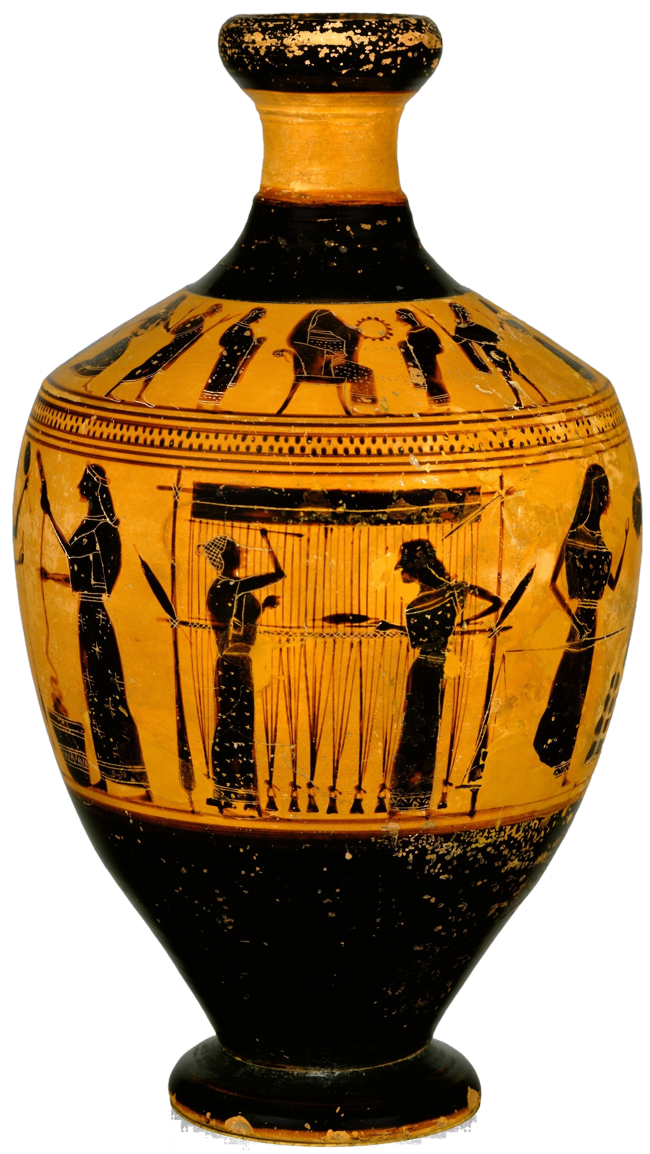
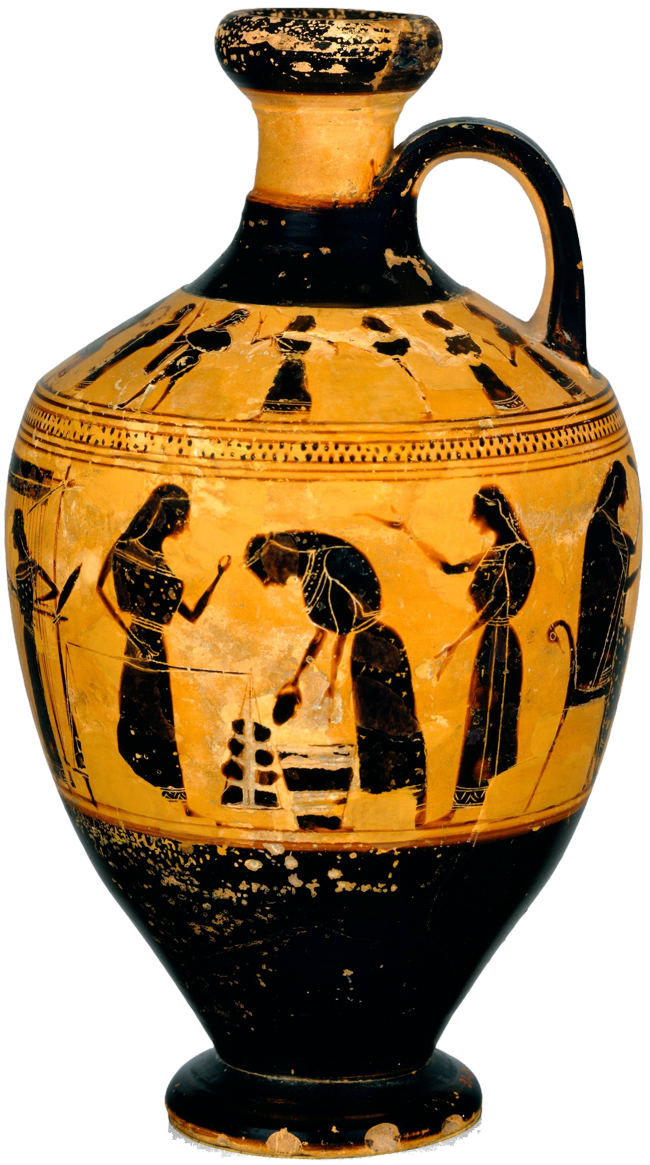
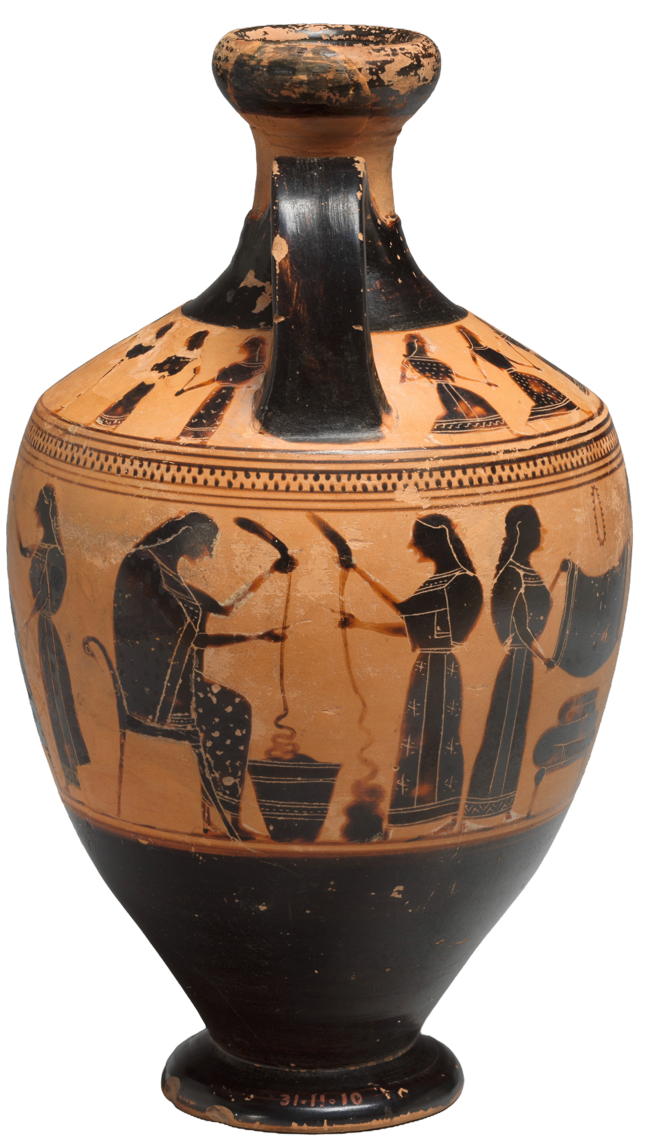
Three scenes of an Attic black-figure lekythos attributed to the Amasis Painter (c. 550-530 BCE). MET 31.11.10.
Gender roles were fairly rigid in ancient Greece. Women were particularly associated with household or domestic duties such as fetching fresh water from springs, directing household servants, rearing children, and, as shown in the vase above, working linen. From the artifact webpage:
"One of the most important responsibilities of women was the preparation of wool and the weaving of cloth. Here, in the center, two women work at an upright loom. To the right, three women weigh wool. Farther to the right, four women spin wool into yarn, while between them finished cloth is being folded" (MET).
When Peisistratus [1] and Menelaus reminisce about the heroes and family members left behind at Troy, Menelaus, Telemachus, Helen, and Peisistratus fall into unseemly lamentation at the feast table:
His words aroused in all of them
A longing for lamentation. Argive Helen,
A child of Zeus, wept; Telemachus wept;
And Menelaus wept, the son of Atreus.
Nor could Nestor’s son keep his eyes dry,
For he remembered Antilochus,
His flawless brother, who had been killed
By Memnon, Dawn’s resplendent son,
And this memory gave wings to his words:
“Son of Atreus, old Nestor used to say,
Whenever we talked about things like this,
That no one could match your understanding.
So please understand me when I say
That I do not enjoy weeping after supper –
And it will be dawn before we know it.
Not that I think it’s wrong to lament the dead.
This is all we can do – cut our hair
And shed some tears. I lost someone myself
At Troy, my brother, not the least hero there.
You probably knew him. I am too young
Ever to have seen him, but men say Antilochus
Could run and fight as well as any man alive.” (4.192-213)
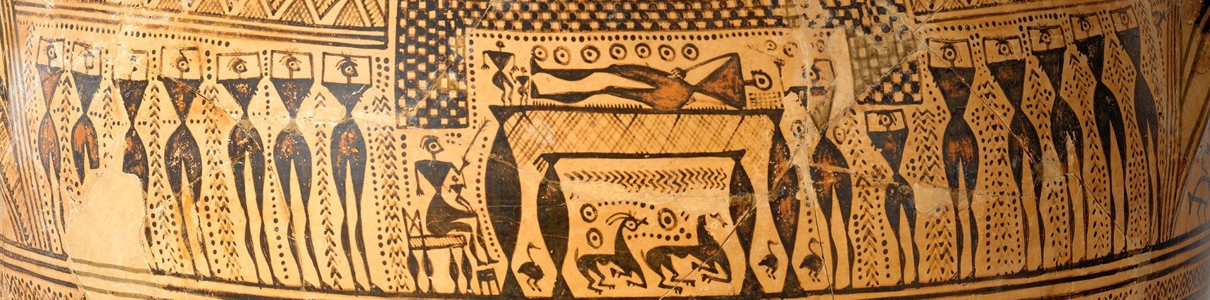
Lamentation, the likes of which Peisistratus describes with warriors and women weeping and pulling out their hair, is depicted in the Iliad. At the news of Patroklos’ death, Achilles famously lost himself in mourning: weeping, griming his face in the dust, and pulling out his hair. As was typically the case in the Iliad, Achilles’ lamentation was on a larger scale and perhaps crossed the line of what was considered civilized or reasonable in the society of the Iliad. Only Achilles and his servant women took to pulling out their hair – Achilles’ fellow kings and warriors merely “wept.” Yet weeping and cutting one’s hair were part of the ritual acts of mourning for the dead in the Homeric world, and they are attested on some of the earliest forms of Greek figural painting in the 8th century – around the time Homer is thought to have composed the Iliad and Odyssey (see inset below).
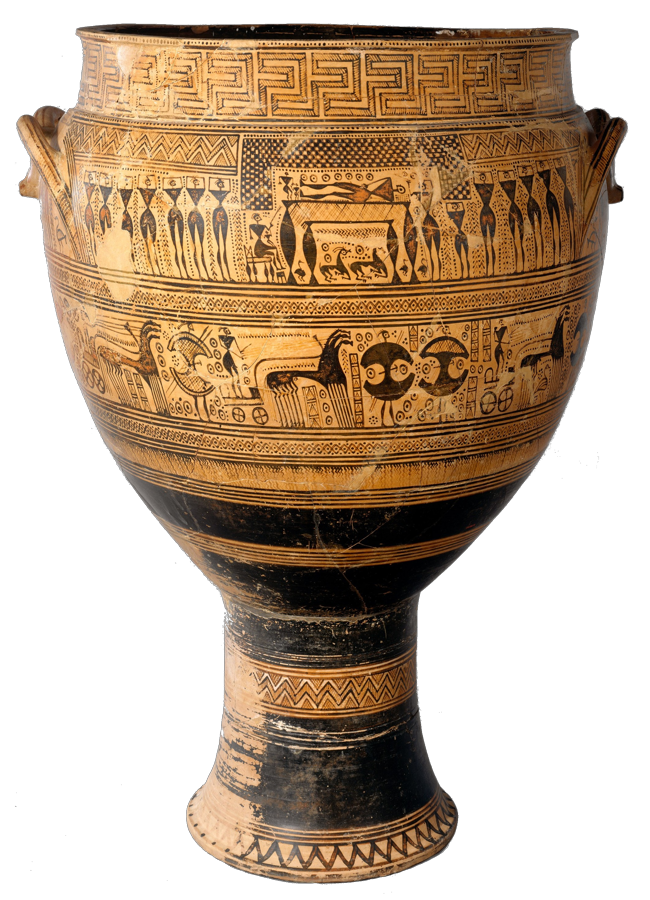
Geometric krater attributed to the Hirschfeld Workshop (c. 750-735 BCE). MET 14.130.14.
“Monumental grave markers were first introduced during the Geometric period. They were large vases, often decorated with funerary representations” (MET).
Observe the detail (below) of the upper frieze depicting a funerary scene in which the deceased is laid out on a bier surrounded by mourners with arms raised over their shoulders and hands meeting atop their heads. The mourners appear to pull out their hair in ritual fashion similar to that described by Peisistratus in Odyssey Book 4.
A nearly identical scene is depicted on another vase marker: MET 14.13.15. These examples are kraters, but other examples exist as monumental neck-amphora (Athens 804).
That said, there are times and places for mourning, and Peisistratus makes it clear that the feast is not one of them. Quite the contrary, the feast is regularly depicted as a forum for gaiety, good natured jests, bragging, dancing, and above all else, storytelling. The raucous scene of the suitors misbehaving in Odysseus’ home on Ithaca was one such example. Although the suitors were depicted as abusing their hosts, the basic outline of festivities at feast parallels those of the court of Alcinous later in the epic and similar descriptions of feasting in the Iliad, such as Achilles playing the lyre and reciting stories of heroes when Odysseus, Ajax, and Phoenix arrive at his tent in Book 9. Thus, when Peisistratus calls a halt to their collective mourning (above), he acts as a Homeric mouthpiece explaining the normative Greek values regarding the two practices: feasting is for merriment and good cheer; whereas mourning the dead is for funeral ceremonies, civic memorial events, and commiseration with friends and relatives in confined moments and spaces.[2]
If Helen represents the gender expectations of Homeric women in this scene, what are we to make of what she does next? The narrative continues twenty-some lines later:
But Helen, child of Zeus, had other ideas.
She threw a drug into the wine bowl
They were drinking from, a drug
That stilled all pain, quieted all anger
And brought forgetfulness of every ill.
Whoever drank wine laced with this drug
Would not be sad or shed a tear that day,
Not even if his own father and mother
Should lie there dead, or if someone killed
His brother, or son, before his eyes.
Helen had gotten this potent, cunning drug
From Polydamna, the wife of Thon,
A woman in Egypt, where the land
Proliferates with all sorts of drugs,
Many beneficial, many poisonous.
Men there know more about medicines
Than any other people on earth,
For they are of the race of Paeeon, the Healer.
When she had slipped the drug into the wine,
Helen ordered another round to be poured. (4.231-250)
Helen’s behavior stands out for a couple related reasons. First, she is an active participant. Aristocratic women in myth are portrayed as passive figures with few exceptions. Indeed, most women in the Iliad, Helen included, are but trophies or prizes for warriors and kings. In other cases from the Iliad, Hecuba and Andromache, they are passive and powerless figures whose words and actions are supplicatory or pleading in nature; the content of their pleas revolves consistently around familial concerns. In fact, when women become active agents in myth, things tend to go badly for them, their loved ones, or the community. Helen ostensibly ignited the Trojan War by “choosing” to run away with Paris, an act that Helen chastises herself for on numerous occasions in the Iliad, and when she is not busy blaming herself, she blames Aphrodite for manipulating her. In other words, Homer implies that the rape of Helen was the product of psychological or emotional processes rather than physical assault or threat.
5th century tragedy had a penchant for magnifying the dangers of women taking action in the figures of Deianeira, Antigone, and Medea. In Sophocles’ Women of Trachis, Deianaera was a literal trophy wife of Herakles, whom he won in a contest against a river god. She was then the passive victim of an attempted rape by the centaur Nessos. Years later, the first active (aggressive?) action she took in her own romantic affairs resulted in the poisoning of her husband (Herakles) and her suicide out of the shame and grief over her fatal mistake. According to the play, Herakles found a younger princess (Iole) that he wanted to make his bride, thus displacing Deianeira. Deianeira’s lone attempt to actively change the trajectory of her romantic life was to apply a love potion to Herakles that would cause him to fall in love with her again, thereby forgetting his plans for Iole. The potion turned out to be poison, and Deianeira inadvertently brought about the death of Herakles. Hence her second (and final) act of will or self-determination in myth: she killed herself.[3]
In the Odyssey, however, Helen acts more like an agent of Zeus and an extension of his will that brought order and justice to the cosmos in Hesiod’s Theogony. This brings us to our second observation of Helen’s depiction in the Odyssey Book 4 that differs from her portrayals in the Iliad. In the Iliad, Helen was a divisive figure. She was a trophy over which the Greeks and Trojans fought, but she was also manipulated against her will by Aphrodite. On the one hand, it is not at all unusual to see humans and gods take actions that are in accord with the will of Zeus. It is quite another thing, however, for a human to be manipulated the way Agamemnon was by Dream (Iliad Book 2) or Helen was coerced by Aphrodite (Iliad Book 3) as opposed to the way in which Helen is represented in Book 4 of the Odyssey. Here, Helen is as another child of Zeus, like Hermes, Apollo, and Athena. Like Helen’s divine half-siblings, her actions are an extension of Zeus’ divine will that bring justice and order to the world. In this case, she takes the decision out of the men’s proverbial hands. They will not think of mourning and lamentation this night, and Helen will make absolutely certain of this fact by drugging their wine. The passage begins with just the slightest reference to Helen as a child of Zeus, but it triggers an entire web of associations that completely change the audience’s understanding of her actions, the assertive actions of a women in a world in which such actions regularly lead to disaster and suffering are reconfigured simply by hinting at her heritage as a child of Zeus. Thus, like other children of Zeus who manipulate the minds of men in Homeric epic, Helen course corrects the men’s minds so that they put aside mourning at feast, where such activity is inappropriate, and instead focus on the telling of stories, which is proper at such gatherings.
Once the men are adequately attuned to their proper role at feast, Helen recounts a fascinating tale in which Odysseus snuck into the walled city of Troy as a beggar, met with Helen, and scouted the city for the eventual Greek offensive:
I couldn’t begin to tell you
All that Odysseus endured and accomplished,
But listen to what the hero did once
In the land of Troy, where the Achaeans suffered.
First, he beat himself up – gave himself some nasty bruises –
Then put on a cheap cloak so he looked like a slave,
And in this disguise he entered the wide streets
Of the enemy city. He looked like a beggar,
Far from what he was back in the Greek camp,
And fooled everyone when he entered Troy.
I alone recognized him in his disguise
And questioned him, but he cleverly put me off.
It was only after I had bathed him
And rubbed him down with oil and clothed him
And had sworn a great oath not to tell the Trojans
Who he really was until he got back to the ships,
That he told men, at last, what the Achaeans planned.
He killed many Trojans before he left
And arrived back at camp with much to report.
The other women in Troy wailed aloud,
But I was glad inside, for my heart had turned
Homeward, and I rued the infatuation
Aphrodite gave me when she led me away
From my native land, leaving my dear child,
My bridal chamber, and my husband,
A man who lacked nothing in wisdom or looks.” (4.258-283)
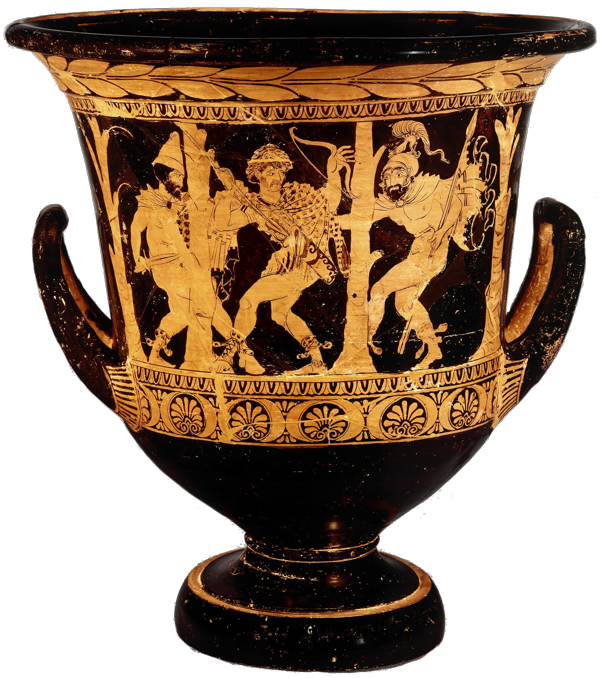
Before we ever meet Odysseus in the Odyssey, his characteristic “deep thinking” or “clever mind” are testified in Helen’s story. In Iliad Book 10, Odysseus and Diomedes went on a nighttime reconnaissance mission in which they captured, interrogated, and slew a Trojan spy, Dolon, who was on a similar mission for the Trojans. Odysseus’ prowess as both a clever thinker and skilled spy in the Iliad foreshadow his later exploit of which Helen describes in the Odyssey (above). Odysseus successfully snuck inside the impenetrable walls of Troy (purportedly built by Poseidon and Apollo[4] ) and slew numerous Trojans. He was also the Greek, with the aid of Athena, who devised the ruse of the Trojan Horse by which the Greeks finally penetrated the walls of Troy and sacked the city.
Lucanian red-figure kalyx-krater (c. 390-380 BCE).
British Museum 1846.0925.3. Background removed (CC BY-NC-SA 4.0).
“Dolon surprised by Odysseus and Diomedes: In the centre is Dolon moving to left, crouching in an attitude of surprise, and looking round. In left hand he holds up his bow, in right he holds a spear which he endeavours to aim at Diomedes. On the left appears Odysseus, on the right Diomedes. Diomedes seizes Dolon with right hand.” (British Museum)
The painting is based on the scene described in Iliad Book 10.
Helen, meanwhile, continues the rehabilitation of her image. On the one hand, she was or has been viewed as the poison that leads men to their deaths. Her beauty and status led to a conflict with Athens in her early years. While she was too young to wed, Theseus (king of Athens) had kidnapped her with the intent of making her his wife. After she was recovered from Theseus and reached a proper age for marriage, every eligible king in the Greek world desired her, either for her beauty or her lineage (as a daughter of Zeus).
Thus Tyndareus (her father and king of Sparta) found himself in a bind. Who could he marry Helen to without creating strife? For surely any king who did not win Helen’s hand in marriage would simply do as Theseus had done and attempt to take her by force or stealth (i.e., illicitly), thus perpetuating an endless cycle of warfare and diminishing the power of all the Greek kingdoms. This dilemma was, at least nominally, the cause of the Trojan War. A Trojan king stole Helen away (whether because of her beauty or lineage or both), igniting a war the likes of which was not known before or after in the Greek consciousness.
All of this occurred earlier in Helen’s life, years before events in Homeric epics. Helen appears notably in the Iliad on three separate occasions, and she is consistently represented as an ideal woman who deeply regrets abandoning Menelaus for Paris. Her self-loathing is so strong that she verbally castigates herself in the harshest of terms while addressing Priam in Iliad Book 3:
“Reverend you are to me dear father-in-law,
A man to hold in awe. I’m so ashamed.
Death should have been a sweeter evil to me
Than following your son here, leaving my home,
My marriage, my friends, my precious daughter,
That lovely time in my life. None of it was to be,
And lamenting it has been my slow death.
But you asked me something, and I’ll answer.
That man is Agamemnon, son of Atreus,
A great king and a strong warrior both.
He was also my brother-in-law – shameless bitch
That I am – if that life was ever real.” (Iliad 3.180-191)
And again, after Aphrodite rescued Paris from certain death in a duel with Menelaus, the goddess encouraged Helen to seek out her Trojan lover, soothe his wounds and sleep with him. Helen’s reply expressed deep opposition, indeed, revulsion at the thought of returning to Paris’ bed:
“You eerie thing, why do you love
Lying to me like this? Where are you taking me now?
Phrygia? Beautiful Maeonia? Another city
Where you have some other boyfriend for me?
Or is it because Menelaus, having just beaten Paris,
Wants to take his hateful wife back to his house
That you stand here now with treachery in your heart?
Go sit by Paris yourself! Descend from the gods’ high road,
Allow your precious feet not to tread on Olympus,
Go fret over him constantly, protect him.
Maybe someday he’ll make you his wife – or even his slave.
I’m not going back there. It would be treason
To share his bed. The Trojan women
Would hold me at fault. I have enough pain as it is.” (Iliad 3.427-441)
Helen’s willingness to aid Odysseus in the story that she tells Telemachus in Odyssey Book 4 is aligned with her Homeric characterization in the Iliad. Indeed, at least since Book 3 of the Iliad, in which Paris clearly lost a duel with Menelaus for the hand of Helen, Helen has expressed a fervent desire to return to her “rightful” or legally “just” place as wife to Menelaus. At least as far as her Homeric depictions are concerned, Helen was a victim of divine capriciousness (as are all humans in relation to the divine). Not only does she welcome and conspire with Odysseus during his infiltration of Troy, but she bathes, clothes, and feeds him as generously as any honored guest-friend.
Lastly, Helen’s story about meeting and conspiring with Odysseus within the city of Troy parallels the interaction that will occur between Odysseus in his palace at Ithaca near the end of the Odyssey. Odysseus will enter his palace disguised as a beggar, be welcomed with open arms by Penelope (ignorant of his true identity), and he will then be bathed, having his feet ceremonially washed by a household servant, Eurykleia, who recognizes Odysseus by an old scar on his leg, and is sworn to secrecy while Odysseus lays out his trap for the suitors infesting his home. In each instance, Penelope, Eurykleia, and Helen play the part of ideal woman, servant, and head of household by welcoming a stranger, recognizing him as an ally, and working with him to bring about justice and order in his household and kingdom.
Menelaus follows Helen’s celebration of Odysseus’ excellence by a story of his one, the earliest literary narrative of the Trojan Horse:
“A very good story, my wife, and well told.
By now I have come to know the minds
Of many heroes, and have traveled far and wide,
But I have never laid eyes on anyone
Who had an enduring heart like Odysseus.
Listen to what he did in the wooden horse,
Where all we Argive chiefs sat waiting
To bring slaughter and death to the Trojans.
You came there then, Deiphobus.
Some god who favored the Trojans
Must have lured you on. Three times you circled
Our hollow hiding place, feeling it
With your hands, and you called out the names
Of all Argive leaders, making your voice
Sound like each of our wives’ in turn.
Diomedes and I, sitting in the middle
With Odysseus, heard you calling
And couldn’t take it. We were frantic
To come out, or answer you from inside,
But Odysseus held us back and stropped us.
Then everyone else stayed quiet also,
Except for Anticlus, who wanted to answer you,
But Odysseus saved us all by clamping
His strong hands over Anticlus’ mouth
And holding them there until Athena led you off.” (4.285-309)
This brief story highlights Odysseus’ famously sharp mind as he was able to see through the trick of Deiphobus. Perhaps more importantly, it highlights another of Odysseus’ virtues, one more poignant in relation to both his experiences in the Odyssey and to human life in the Homeric world generally: Odysseus’ ability to endure or suffer.
Odysseus’ most popular epithet is almost certainly “wily Odysseus,” or similarly translated terms that reference the hero’s deep cunning. However, “long suffering Odysseus” translates a group of epithets that are also regularly applied throughout the epic. Menelaus’ recollection of Odysseus in this short story, before Odysseus even makes an appearance in the epic named after him, lays the groundwork for all of Odysseus’ adventures. While most of his exploits involve some sort of cunning on the part of the hero, it is continual suffering and the ability to endure such suffering that represent the major lesson of the epic. For not everyone is as “wily” as Odysseus, but all humans in the Homeric world suffer and endure. As Apollo states in Book 24 of the Iliad: “The Fates put in mortal men the heart of endurance” (24.49). This conflict between loss, the desire to give up, and the ability to endure suffering will become a pervasive theme in the Odyssey and stands alongside the role of xenia as a major, conscious lesson, theme, or cultural belief that the epic affirms for its audience.
One more tale was told the following morning. Telemachus explained his desire to learn word of his father for fear of the dire situation with the suitors back on Ithaca. This gave Menelaus an opening to launch into the discussion of four ‘returns,’ those of Oelian Ajax (Lesser Ajax), Agamemnon, Menelaus, and Odysseus.
Oelian Ajax was shipwrecked and eventually drowned by Poseidon due to his repeated outrages against the gods. During the sack of Troy, Oelian Ajax is famously depicted tearing the Trojan princess Cassandra away from a statue of Athena to which she clung and claimed sanctuary. Violently slaughtering or carrying away suppliants in a god’s sanctuary is a serious crime in Greek myth and in historical precedent as well. Menelaus’ retelling of Ajax’s fate multiplies the outrages of the hero by further defying the gods after his ship was wrecked at sea, for “He would have escaped, / Despite Athena’s hatred, but he lost his wits / And boasted loudly that he had survived the deep / In spite of the gods” (4.527-530). Poseidon then struck the ground with his trident, sundering the small rock onto which Ajax clung and drowning him in the sea, his death caused by his own “blind arrogance.”
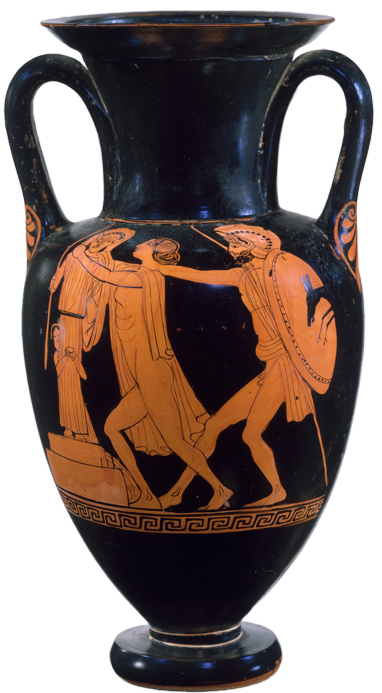
Attic red-figure neck-amphora attributed to the Ethiop Painter (c. 450 BCE). MET 56.171.41
Lesser/Oelian Ajax drags Cassandra away from the statue of Athena where she ran to sanctuary. During the sack of Troy, the Greeks committed outrages against the gods by butchering Trojans in the sanctuaries of the gods as well as violently seizing suppliants as Lesser Ajax is shown doing here.
A red-figure hydria by the Klephrades Painter (Naples, Museo Nazionale Archeologico) is the most popular of such depictions that exists today.
Menelaus’ fantastical return is closer to that of Odysseus’ in that he was blown into foreign lands and struggled with divine/inhuman forces before, with divine aid, finding his way safely home. While stranded on the shores of Egypt, the sea nymph Eidothea, a daughter of the sea god Proteus, took pity on Menelaus and told him how he cold trap her father and gain his divine knowledge about how to return home. Before telling Menelaus how he could make his way home, Proteus informed Menelaus of the fates of Agamemnon and Odysseus.
Agamemnon survived the scattering of the Greek fleet by Poseidon and Athena, but when he reached home, he was ambushed and slaughtered by his cousin Aegisthus who had seduced his wife and taken power in Mycenae while the king was away. The family history of Agamemnon is riddled with kin-killing, and a 5th century tragic trilogy by Aeschylus, dubbed the Oresteia, dramatizes the final generations of the familial drama while alluding to past crimes within the family. The entire trilogy has survived to the modern day. Like many 5th century tragedies, it presents differing versions vis-à-vis that of Homeric epic. In this case, Agamemnon’s wife, Clytemnestra, is the family member who murders Agamemnon, thrusting their son, Orestes, into an ethical bind in which he must choose between loyalties to his parents, both of whom committed crimes against the family.
[1] Peisistratus is the son of Nestor sent to accompany Telemachus to Sparta from Pylos. Both princes represent the burgeoning generation of aristocracy in the Homeric world.
[2] Restraint is a problem for Achilles, so his example is difficult for us to derive norms or values from, but it is clear that he goes too far in his mourning when he refuses to bathe or eat while consumed by grief. The “lesson,” as it were, is that one must not allow mourning to reach unchecked extremes that disrupt or inhibit a properly functioning society. Similar lessons, often surrounding Achilles and his rage, pervade the Iliad. Pesistratus suggests something similar here, in Odyssey Book 4: expressions of grief, when regulated, are features of a healthy society.
[3] For a fascinating exploration of female figures in 5th century tragedy, see Nicole Loraux’s Tragic Ways of Killing Women . Harvard UP (1991). It is a quick and accessible read, but one must first read, or at least familiarize oneself, with the plots of surviving tragedies by Sophocles and Euripides.
[4] According to Apollodorus, Apollo and Poseidon appeared before Laomedon as mortal masons and offered to build the walls of Troy for free. This was a test of Laomedon’s “insolence,” and indeed he did not thank them with any kind of gift or payment (Book 2.103). Apollodorus’ Library and Hyginus’ Fabulae: Two Handbooks of Greek Mythology. Trans. R. Scott Smith and Stephen M. Trzaskoma. Hackett (2007).