The Lombardo abridgement omits Book 7 and the first 500 lines of Book 8. In brief, the abridged material includes the formal supplication of Odysseus, first to Queen Arete and then King Alcinous. The king and queen grant Odysseus xenia and proceed to follow through with the customs of welcoming, entertaining, and feasting with their new guest-friend (xenos). Odysseus is challenged by a young Phaeacian to a discus competition, and Odysseus easily defeats the challenger with the help of Athena. This scene recalls a similar series of athletic contests in the Iliad Book 23, held by Achilles in honor of the recently buried Patroklos as well as the way in which heroic success or failure on the battlefield hinged on the favor of one god or another. Athletic competitions, such as the discus match or series of games at Patroklos' funeral, are commonly used in celebratory festivities, whether it's celebrating a deity, a polis (city-state), a deceased comrade, or welcoming a guest-friend. The fact that Odysseus defeats the upstart challenger both foreshadows and parallels Odysseus' future contest with the suitors, which will occur in the form of an archery contest when Odysseus returns to his ancestral halls on Ithaca later in the poem.
The rest of Book 8 introduces us to the bard of the Phaeacians, Demodecus, which reinforces archaic ideas about the role or function of poetry in Greek civilization. When Alcinous notices Odysseus begin to cry at the playing of the bard's song, Alcinous calls a halt to festivities, and Book 8 ends on a cliff hanger in which Odysseus is once again about to reveal his name. These two brief incidents will be the subject for the remainder of this essay.
The role of the poet, and poetry in general, in Homeric and Hesiodic verse is a popular topic for Classical and mythological studies. What follows is a very brief summary of an argument one can find more thoroughly fleshed-out in the reading of the "Invocation of the Muses," the introductory element of Hesiod's Theogony, on this website; it is also a core thread in our analysis of the Iliad. Poets are to the Human world what the Muses are to the Olympians: their arts ("music", arts of the Muses) celebrate (honor!) the subjects about whom they sing. By singing of the deeds of Zeus, Apollo, Herakles, Perseus, etc., the poet or Muse entertains their audience and facilitates their memory - literally reminding them of the great deeds performed by the gods or heroes who are the subject(s) of their songs. In this way, the poet or artist honors/celebrates/venerates the god or hero by perpetuating the fame of their deeds. Furthermore, in Odyssey Book 1, Penelope tried to prevent Phemius, the bard, from singing about the Returns, the godsent hardships that the Greeks suffered on their return journeys from Troy. Telemachus interrupted her forcefully:
"Mother, why begrudge our singer
Entertaining us as he thinks best?
Singers are not responsible; Zeus is,
Who gives what he wants to every man on earth.
No one can blame Phemius for singing the doom
Of the Danaans: it's always the newest song
An audience praises most. For yourself,
You'll just have to endure it and listen.
Odysseus was not the only man at Troy
Who didn't come home. Many others perished. [1]
The stories told by the bards in an oral culture do not simply celebrate heroes and remind the members of their civilization what they did. They also carry news to and from distant places, and the bard is to be honored for his part in this reciprocal chain. For while he spreads the fame of gods and heroes, he too receives fame and status for a story well told (or sung). Thus the bard is honored as well as his subjects. We see this in Odyssey Book 8 when Odysseus offers Demodocus a prime cut of meat ahead of his performance and then asks him to tell his own story, the sack of Troy. Note the reverence Odysseus bestows on the role of the bard:
"Herald, take this cut of meat to Demodocus
For him to eat. And I will greet him
Despite my grief. Bards are revered
By all men upon earth, for the Muse
Loves them well and has taught them the songways." [2]
As Demodocus poignantly and accurately recalls the events at Troy - events he was not there to witness and has, we are led to believe garnered such specific knowledge via divine inspiration - Odysseus begins to quietly cry. The rest of the attendees do not notice Odysseus' tears, with the exception of Alcinous, who immediately calls a halt to the festivities out of decorum befitting the role of a host entertaining his guest-friend:
"Hear me, Phaeacian counselors and lords --
Demodocus should stop playing his lyre.
His song is not pleasing to everyone here.
Ever since dinner began and the divine bard
Rose up to sing, our guest has not ceased
From lamentation. He is overcome with grief.
Let the lyre stop. It is better if we all,
Host and guest alike, can enjoy the feast.
All that we are doing we are doing on behalf
Of the revered stranger, providing him
With passage home and gifts of friendship.
A stranger and a suppliant is a s dear as a brother
To anyone with even an ounce of good sense. [3]
Like many of the episodes in Homeric epic, the scene and even the very words repeat or directly parallel prior and future scenes in the epic. Suffice to say, like his daughter, Nausicaa, Alcinous is a pious, god-fearing and civilized host who practices xenia and goes about it correctly. In this way, Alcinous is what the Romans would refer to as pietas, the root word for "piety" or "pious." The concept of pietas goes beyond religious piety as the term is used today. While it certainly included religious piety, it is best translated as "duty," duty to the gods, but also to one's family (familial piety) and to one's community (civic piety). One who is pietas is one who does this properly, the right way and without cutting corners. One might say he "thinks right" and "acts right" according to the norms and mores of his culture, which he has internalized. These characteristics are best exemplified in the Iliad by Hektor (Book 6) and Aeneas in Virgil's Aeneid, but they attach themselves to almost every figure in the Iliad - perhaps short of Thersites. These are characteristics of a proper mortal on earth, as Odysseus' interactions with different peoples, monsters, and gods will flesh-out throughout the epic. The proper observation of xenia is an outward show that expresses oneself as god-fearing, knowing one's place in the cosmos, and thus practicing religious piety.
Detail of shoulder, red-figure hydria attributed to the Kleophrades Painter (c. 480 BCE).
Napoli, Museo Archeologico Nazionale 2422-2023.
Photo: Carlo Raso (PDM 1.0)
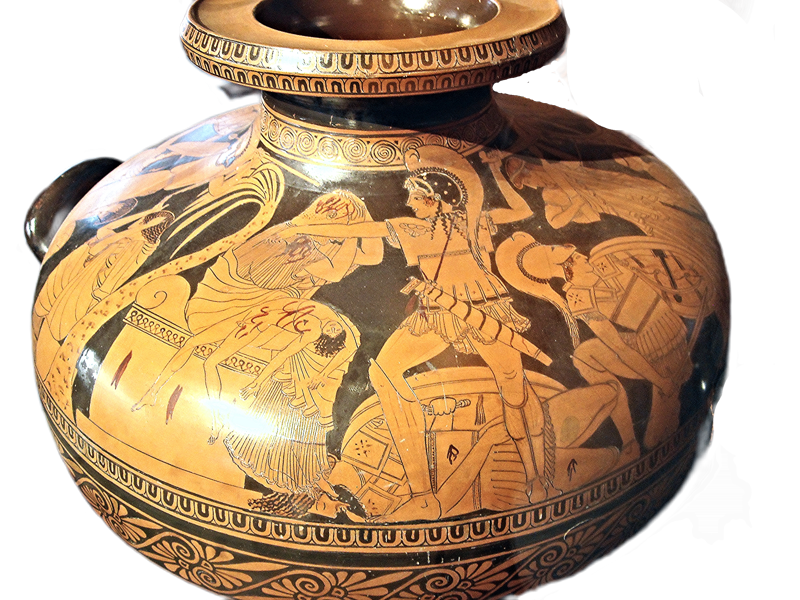
The Iliupersis ("Sack of Troy") is depicted around the shoulder of this hydria. The three most famous deeds of the Iliupersis are painted on the vase:
1.) Neoptolemos slays Priam, seated on the altar of Zeus, with the corpse of Astyanax sprawled on his lap; This scene is visible in the image (left);
2.) Oilean Ajax forcefully drags Cassandra away from the statue of Athena (partially visible;
3.) Aeneas escapes the carnage with his father, Anchises, on his shoulder and leading his son, Ascanius, by the hand (not visible).
The Priam and Cassandra scenes convey the savagery of the Greeks, who violated the sanctity of the gods' sanctuaries in their lust for vengeance upon the Trojans. This savagery is contrasted with the pietas (familial piety) of Aeneas, who dutifully guides the three living generations of his family away from the destruction.
The deaths of Priam and Astyanax represent the end of the three "living" generations of the Trojan ruling family: Priam and Astyanax are the older and younger generations, while Hektor, who was slain by Achilles earlier in the war, is missing and would presumably have fulfilled the role of protector/rescuer that Aeneas performs in this painting.
After calling a halt to the Demodocus' song, Alcinous once again asks Odysseus what his name is and where he is from. This is not the first time Arete and Alcinous have asked him this, but he has not as yet divulged his identity. Sharing one's name and place of origin (homeland) with a host is part of the xenia ritual. So it is unusual that, by the time of the feast, Odysseus has yet to inform his host of his name, his lineage, and what land he calls home. There is a certain irony to this, for much of Odysseus' troubles could be laid at the fact that he did give his true name to one of his "hosts," the cyclops Polyphemos, and that led directly to the wrath of Poseidon who still hounds him to this moment of the epic. Nevertheless, Odysseus finds himself trapped by very bonds of xenia that have aided him to this point on the island of Scheria: either share his name and complete the xenia covenant, or violate it and show himself to be an uncivilized savage. Odysseus will, of course, answer Alcinous and do so truthfully. He is among fellow civilized peoples who have treated with kindness and respect. He will do the same in kind.
In his attempt to get Odysseus to speak freely about his origins to him, Alcinous provides some background with regard to the technology or special standing of the Phaeacians in the Homeric world. They exist as something of an in-between or blessed race of mortals between regular humans and the gods. They live far apart from other human civilizations, and they enjoy a sailing technology that is vastly superior. Alcinous describes it as follows:
Tell me your name, the one you were known by
To your mother and father and your people back home.
No one is nameless, rich man of poor.
Parents give names to all of their children
When they are born. And tell me your country,
Your city, and you land, so that our ships
May take you there, finding their way by their wits.
For Phaeacian ships do not have pilots,
Nor steering oars, as other ships have.
They know on their own their passengers' thoughts
And know all the cities and rich fields in the world
And they cross the great gulfs with the greatest speed,
Hidden in mist and fog, with never a fear
Of damage or shipwreck. [4]
The Phaeacians are like the race of Neumenorians in J. R. R. Tolkien's Lord of the Rings saga. In Tolkien, they were a race of superior, long-lived men descended from the allies of Elves in the First Age and were granted the island of Numenor by the Valar (the Tolkien equivalent of the Olympians). Thus, they lived a more technologically advanced and largely separate life from other human civilizations, blessed by the gods. However, the Numenoreans, like the Phaeacians, were still mortal, no matter how much better than ordinary humans. And they could still run afoul of the gods, which they did in Tolkien's fantasy novels, and which the Phaeacians will do in the Odyssey.
Book 8 ends with Alcinous' explanation of how xenia works, his reassuring words that he and his people would give Odysseus the requisite aide due an accepted suppliant and guest-friend, and that it was now time for Odysseus to share his identity and story with the Phaeacians.
[1] Odyssey 1.366-75. The Essential Homer. Trans. Stanley Lombardo. Hackett (2000). See "invocation to the Muses," Theogony lines 1-115, for a poetic explanation of how and why bards are granted this gift by the Muses.
[2] Odyssey 8.514-8. ibid.
[ 3] Odyssey 8.575-92. ibid.
[4] Odyssey 8.596-609. ibid.